Select country: AUS | US
Select country: AUS | US


The blood test designed to rule out Oesophageal Cancer.
Notice: This healthcare provider has applied to the Australian Digital Health Agency for an extension of time to comply with My Health Record information-sharing requirements. Pending the outcome of this application, healthcare information from Proteomics International is not currently being shared with the My Health Record system. This notice is displayed in accordance with Australian Digital Health Agency requirements.
Clinically proven
2,100+ collection sites
Actionable results

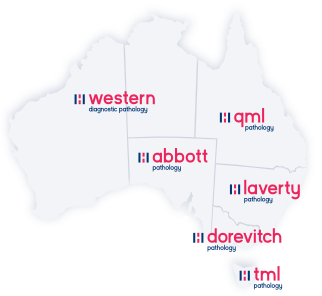
Exclusively accessible nationwide in Australia through the Healius Pathology Network, with a referral from your healthcare provider.
Oesophageal Health Test
Gastro-oesophageal reflux disease (GORD) affects 1 in 10 Australians but it could be more serious than you think.1
GORD is one of the most common gastrointestinal conditions in Australia.1 While often manageable, long-term acid reflux can damage your oesophageal lining and increase your risk of developing a type of oesophageal cancer called oesophagael adenocarcinoma.2,3,4
Most people with GORD will never develop oesophageal adenocarcinoma.5 However, based on your individual circumstances and risk factors, your doctor may choose to investigate further, usually with an endoscopy.
There’s a simple way to assess your cancer risk
This new blood test can help estimate your risk of oesophageal adenocarcinoma quickly and conveniently.
Compared with endoscopy, this test is:
-
Faster: a standard blood draw
-
Easier: no fasting, sedation, or recovery time
-
More convenient: no time off work or someone to drive you home after the procedure
Your blood sample is analysed in our lab and we provide the test report within 2 to 4 weeks. Talk to your preferred health care provider to learn more.
Rule out oesophogeal adenocarcinoma (cancer)
- Sample type: blood test
- Authorisation: Your preferred health care provider
- Results: 2 to 4 weeks from sample collection
- Who is it for? Patients with persistent heartburn or GORD
Note: This test requires authorisation from a licensed medical provider. You can download the test referral form below and take it to your preferred health care provider to order the test.
How it works

Get medical authorisation
Download the referral form to take to your next appointment with your preferred health care provider to get medical authorisation.

Provide your sample
No appointment needed. Just take your signed test requisition form with you to a Healius Pathology Network blood collection centre.

Get answers in days
Your health care provider will get an email when your results are ready, within 2 to 4 weeks. They may schedule a follow-up consult with you.


This test is performed in our NATA certified laboratory, which is accredited for compliance with NPAAC Standards and ISO 15189.
Notice: This healthcare provider has applied to the Australian Digital Health Agency for an extension of time to comply with My Health Record information-sharing requirements. Pending the outcome of this application, healthcare information from Proteomics International is not currently being shared with the My Health Record system. This notice is displayed in accordance with Australian Digital Health Agency requirements.
Make informed healthcare decisions
Highly accurate
The oesophageal Health Test has been shown to rule out oesophageal cancer with 99.9% accuracy (Negative Predictive Value)11.
Simple and convenient
This test requires a standard blood collection, analysed by our lab, which will provide a report on your risk for oesophageal adenocarcinoma (cancer).
Fast, high-quality results
Your sample is analysed in our accredited Australian lab.
Make informed health choices
These results may help you and your doctor better manage your chronic acid reflux and better understand your risk of oesophageal adenocarcinoma (cancer).
Take your next step with confidence
Know your risk and your doctor can help you make your next healthcare decision with confidence.
Find a blood collection location
This test is exclusively accessible through the Healius Pathology Network in Australia.
Are you a medical professional?
The blood test designed to predict the onset of chronic kidney disease up to four years before symptoms appear.
Frequently asked questions
Oesophageal Health Test vs Endoscopy
Oesophageal Health Test vs Endoscopy:
- Simple, non-invasive blood test vs invasive procedure
- Quick test vs potentially a long waiting period for the endoscopy to be scheduled and having to take time off work
- Results within 2 to 4 weeks vs potentially a long waiting time for the endoscopy to be scheduled as well as 1-3 weeks for the results
Endoscopy also requires:
- Fasting the night prior to procedure
- Someone to drive the patient home from the hospital/clinic after the procedures.
Cost benefits
Private health insurance patients also face significant co-payment for their endoscopy procedure, as well as their GI specialist office visit(s).
Who should take this test?
People with chronic acid reflux (also known as Gastro-oesophageal Reflux Disease - GORD) who are discussing endoscopy with their doctor to rule out a common type of oesophageal cancer called oesophageal adenocarcinoma.
Suitable candidates include people who have been diagnosed with Barrett’s oesophagus who are on surveillance endoscopy.
Eligibility criteria for this test include:
- No prior cancer diagnosis
- Frequent heartburn or chronic acid reflux (GORD)
- At least one risk factors for oesophageal adenocarcinoma, including:
- Age > 50 years
- Overweight (BMI > 25 kg/m2)
How does the test work?
The test measures four glycoprotein biomarkers in the blood, and these measurements are then combined with age, sex and BMI in a statistical model to assess your risk of oesophageal adenocarcinoma.
The test results use a traffic light system to classify your risk of oesophageal adenocarcinoma:
- Green = low risk of oesophageal adenocarcinomao
- Amber = moderate risk of oesophageal adenocarcinoma
- Red = high risk of oesophageal adenocarcinoma
How does the test help rule out oesophageal adenocarcinoma?
The oesophageal Health Test is a non-invasive blood test for the detection of oesophageal cancer. It identifies 4 biomarkers in the blood that are linked with this type of cancer, then combines this with age and body mass index (BMI) data to calculate a risk score. Clinical studies validating this test have reported high accuracy, with the test's ability to "rule out" oesophageal cancer with a 99.9% negative predictive value11.
Am I eligible for the test?
To be eligible, you must not have had prior cancer diagnosis and exhibit frequent heartburn or acid reflux (also known as Gastro-Oesophageal Reflux Disease (GORD)).
You also need to have at least one of two risk factors for EAC (oesophageal adenocarcinoma), including:
-
Age > 50 years
-
Overweight BMI > 25 kg/m2
How do I take the test?
Follow these simple steps to take the oesophageal health test:
-
Download the test referral form.
-
Take the referral form to your health care provider to discuss your eligibility.
-
Take the signed referral form to a Healius Pathology Network blood collection centre and have your blood sample taken.
-
Wait for your doctor to contact you.
How much does it cost and can I get a Medicare rebate?
The oesophageal health test costs $997. As the test is new, it is not yet covered by Medicare.
Do I need a doctors referral?
Yes. You can get a referral from your preferred health care provider.
How long until I get my results?
2 to 4 weeks depending on where you are located.
Are my results and personal details kept private?
We know health information is sensitive and we take your privacy very seriously. Your test results are private and confidential.
Our laboratory system stores your personal information on highly secure, encrypted servers. This information is never shared with third parties without your explicit approval. See our Privacy Policy for further information.
References
- Keung C, Hebbard G. The management of gastro-oesophageal reflux disease. Aust Prescr. 2016;39(1):6-10.
- van Zanten SV. Chronic GERD and risk of esophageal adenocarcinoma: Should we screen with gastroscopy? CMAJ. 2020;192(27):E781-E782.
- Tran CL, et al. Gastroesophageal reflux disease and risk of cancer: Findings from the Korean National Health Screening Cohort. Cancer Med. 2023;12(18):19163-19173.
- McColl KE. What is causing the rising incidence of esophageal adenocarcinoma in the West and will it also happen in the East? J Gastroenterol 2019;54(8):669-673.
- Rubenstein JH, Shaheen NJ. Epidemiology, Diagnosis, and Management of Esophageal Adenocarcinoma. Gastroenterology 2015;149:302-317.
- Bray F. et al, (2024) CA Cancer J Clin. 74(3), 229-263
- Dam et al., (2020) Ann. Transl. Med., 8(17): 1107
- Stawinski et al., (2023) Diagnostics (Basel). 13(2), 321.
- Visrodia et al., (2016) Gastro., 150(3), 599-607.e7
- https://www.proteomics.com.au/wp-content/uploads/240201-ASX-PIQ-Study-validates-biomarkers-for-oesophageal-cancer-blood-test.pdf
- Sheahan J, et al., A Clinical Validation of a Diagnostic Test for Esophageal Adenocarci noma Based on a Novel Serum Glycoprotein Biomarker Panel: PromarkerEso. Proteomes (2025). 13(2), 23.

Follow us:
Select country: AUS | US
6 Verdun Street, Nedlands WA, Australia 6009
Contact Us
Privacy Policy